

More local and more qualitative than usual. The evidence is what I see walking Basel and what friends inside the industry tell me. Not a forecast — a reading.
A few times over the years I’ve taken the photograph that ends up at the top of a Google Maps listing. A new research building at the ETH Zürich satellite in Basel where I worked. Lecture theatres at the London universities I studied at. A few other places. I could not voice for the longest time why I did it. The views across all four hundred or so photos add up to something like five million.
I think now it was something specific — I was reading the city for monuments without knowing it. Don’t get me wrong: I’m not nostalgic. I only care about what’s coming.
Which is what I want to do here, deliberately, sitting next to the Basel post building.
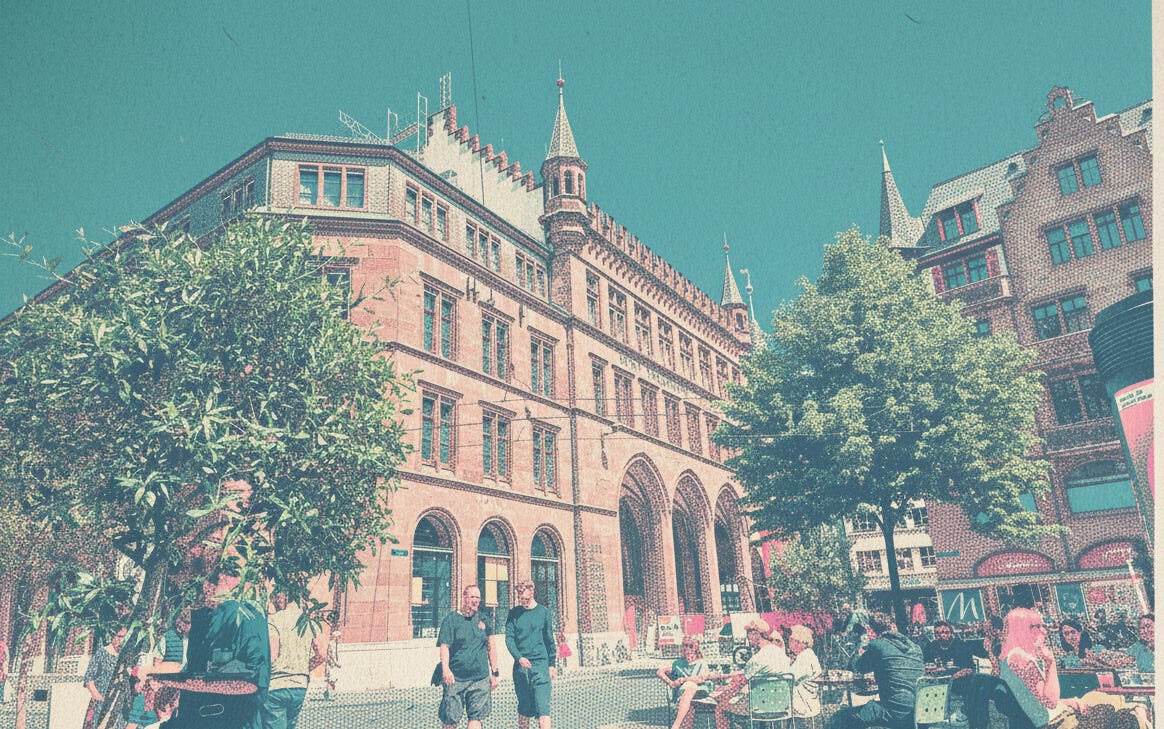
I’m sitting at a café table on the Marktplatz, looking at the post building. Sandstone, gothic, corner turret. Half of it stands empty; the other half is in renovation netting. The kind of building a city would put on a stamp.
The framing is borrowed from cathedrals. Pointed arches, tracery, weight. But the building wasn’t moving prayers — it was moving letters and parcels. The same arc that railways, telegraph, telephone all walked: private innovation, state capture, state monumentality, re-privatisation. Then the function moves on. The substrate of moving information is now a windowless box where the high-voltage lines come in. There is no AWS facade on Rheingasse, no Google Cloud bell tower yet.
Call it the facade lag. Institutions keep their architectural form long after the function dies. Churches held the town square for a century after secularisation. Post buildings did the same. Bank branches are mid-collapse right now.
The lag is information. When something is being built monumentally — not just functionally — the institution is usually at its peak. Hungry institutions build sheds; mature ones build statements.
What’s being built monumentally today is the answer to the question of what’s about to ossify.
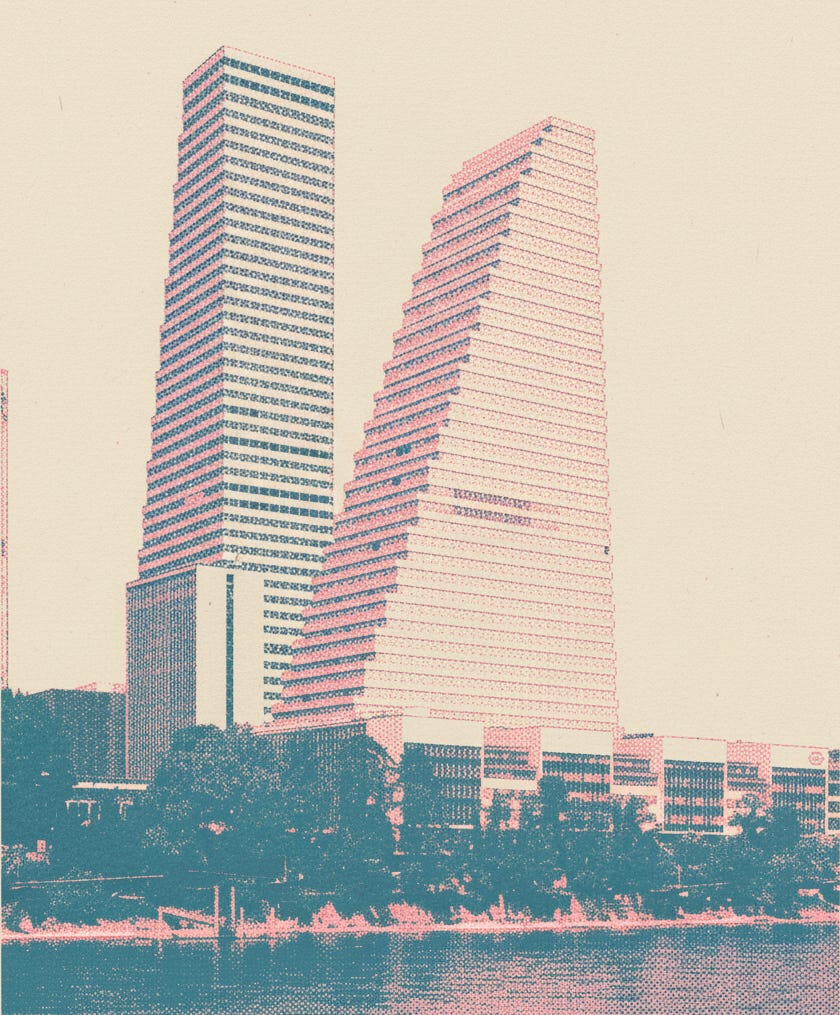
Roche Bau 1 + Bau 2. Roche and Novartis are Switzerland’s two most valuable listed companies.1 Bau 1 opened 2015 — 178 metres, briefly the country’s tallest. Bau 2 followed in 2022 at 205 metres, taking the title.2 By the standards of any real metropolis these are unremarkable buildings; for Basel — 200,000 people,3 where pharma and life sciences are roughly a third of the workforce4 — they’re outsized. Roche could have built horizontal — Kaiseraugst is twenty kilometres away with cheap land. They didn’t. The towers are deliberate statements: vertically integrated, secretive, capital-intensive pharma at peak confidence about what it is — ten thousand people in one place, finding a molecule.5
Increasingly, that work happens in data centres instead — with ever more targeted search for the right molecule. The same medium shift that hollowed out the post applies here: ten thousand people in one place → fewer people, more compute, more targeted search. The Roche tower is what that work used to look like. Bau 3 is planned for 2029 or 2030. The question isn’t whether it’ll be built. It’s what comes after.
The Biozentrum and the D-BSSE. University of Basel (2021), and ETH (2024). Sit next to each other on the Schällemätteli campus, two kilometres east of the Roche site, doing largely the same wet-lab-meets-computation work, just funded by different institutions. The Biozentrum is the visible one — tall, civic, that's the new biology building. D-BSSE is monumental on the inside, quieter outside. The Google Maps photo I uploaded a few years ago was of D-BSSE — the ETH research building I worked in, the one from the opening. I think I knew, without knowing, that I was photographing the quieter half of the pair.
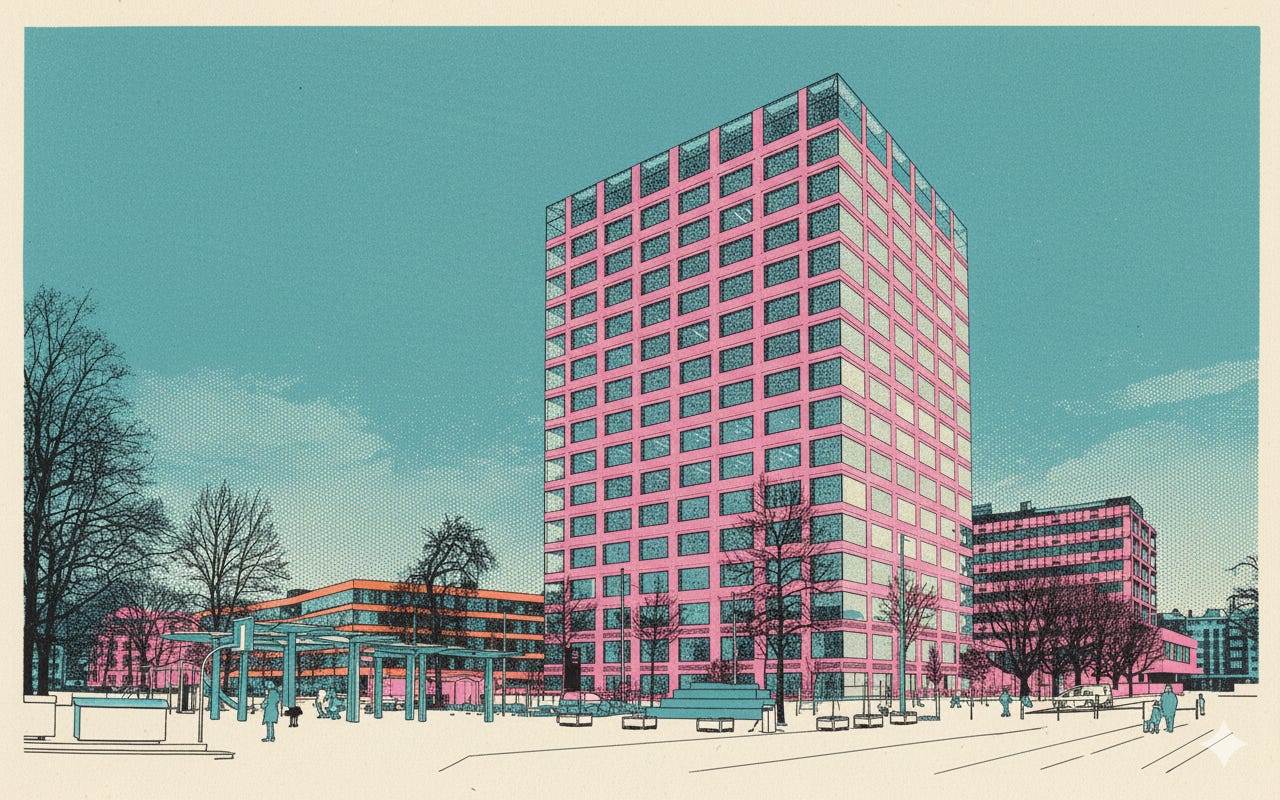
The Biozentrum. What the city sees.
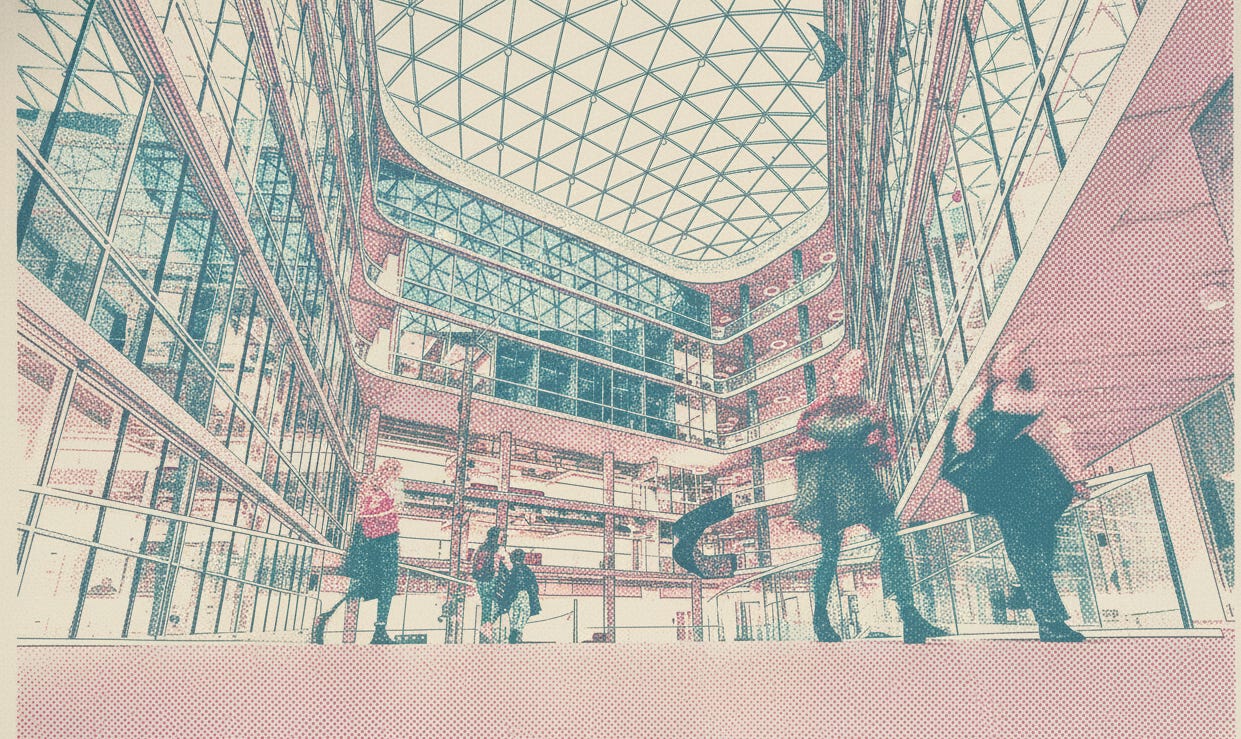
The D-BSSE atrium. What the people inside see.
Both are part of a wider Basel move, underway about a decade. The Schällemätteli campus is steadily filling in with interdisciplinary bio-and-medicine buildings — the Kinderspital, a Biomedicine building already half-built.6 The cluster is the point.
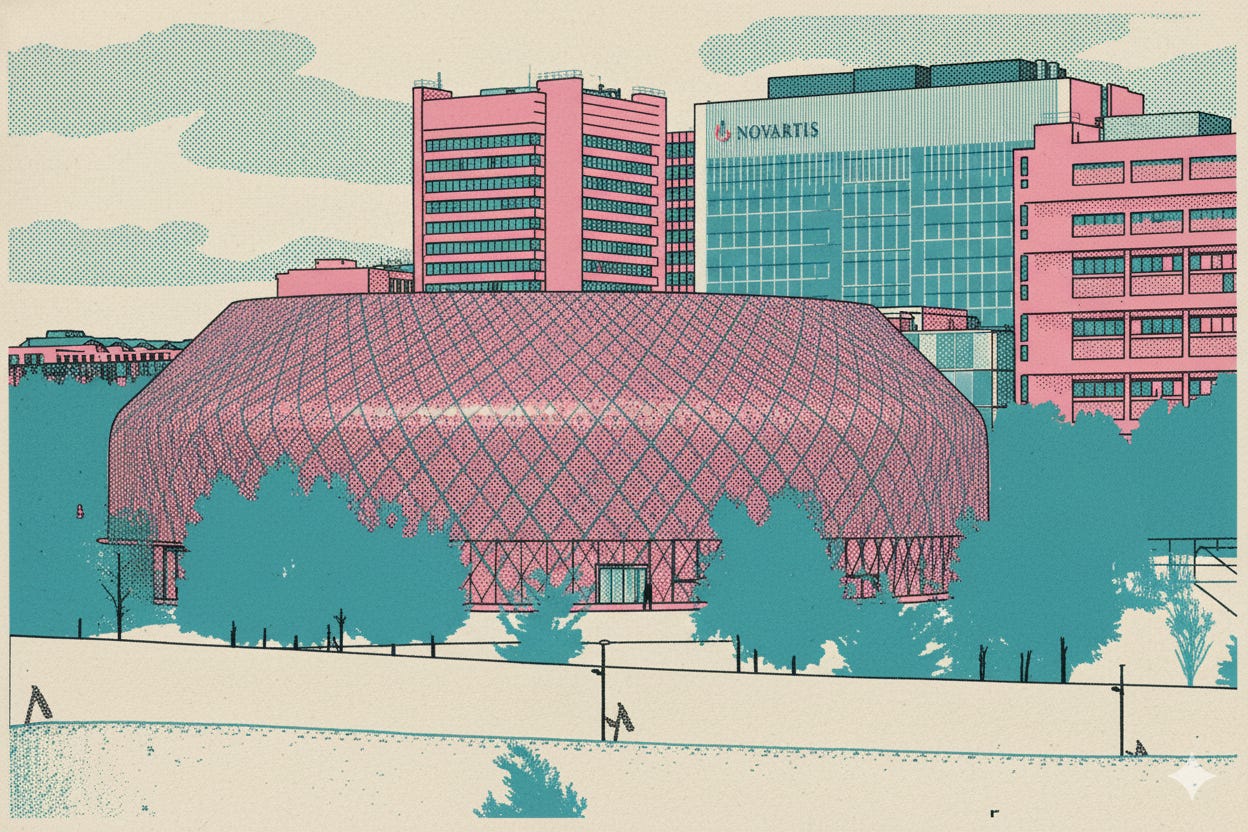
The Novartis Campus, two kilometres west, is the counter-argument. A scientific village — low, horizontal, distributed across many buildings, no tower and no single statement. Two competing theories of what pharma is, built two kilometres apart.
Roche = the last monument of the old pharma paradigm. The Schällemätteli cluster = the first civic monumentalisation of the next era, distributed rather than concentrated. Novartis = the horizontal counter-bet, that monumentality itself is the wrong move. Three readings of the same moment in the same city.
Worth coming clean about why this reads to me the way it does. There's a saying: if all the surfaces around you are polished, you're not at the frontier. I had it in my head when I left D-BSSE — moved from a temporary building, mismatched walls, every meeting room something else last year, into the polished new one with glass atrium and branded coffee. The work was — and is — top-notch; academic research may be one of the exceptions. But the saying is what put me on this article. Polish marks the end of motion.
Back to the café on the Marktplatz. Sitting here, I wonder where the next monument is — the one that will decorate this city in fifty years. The post building of today.
What does the state still monumentalise? Less than it used to — and almost none of it in cities. Mountain dams. Trans-alpine tunnels. Sea walls. Deep underground physics labs. The remaining state-monumental capacity has migrated to the fringes — capital-intensive infrastructure at the periphery, justifiable as public spend, far from anywhere most people see it. Throughout the long 20th century a state could plausibly monumentalise the post, the railway, the telephone, broadcast TV, the bank, the hospital — buildings in the centre of cities, things anyone might walk past. Most of those layers are now private, or anonymous, or gone. What survives is at the edges.
Roche Bau 3 will open in 2029 or 2030. By then this article will be three or four years old. We’ll know whether I was reading the buildings or just describing them.
The bet isn’t that big pharma ends. There are real reasons the model exists at scale — mass parallel testing, billion-dollar clinical trials, absorbing the losses from low hit rates. None of that goes away because compute got faster. The bet is that the way scale gets built changes: closed-loop bio labs, foundry-style infrastructure, targeted search across many smaller sites instead of one tower full of scientists. If Bau 3 is the last vertical monument on the Roche site, that’s reinvention, not extinction. The hard biology stays hard either way — good data is scarce outside proteins, validation still costs years.
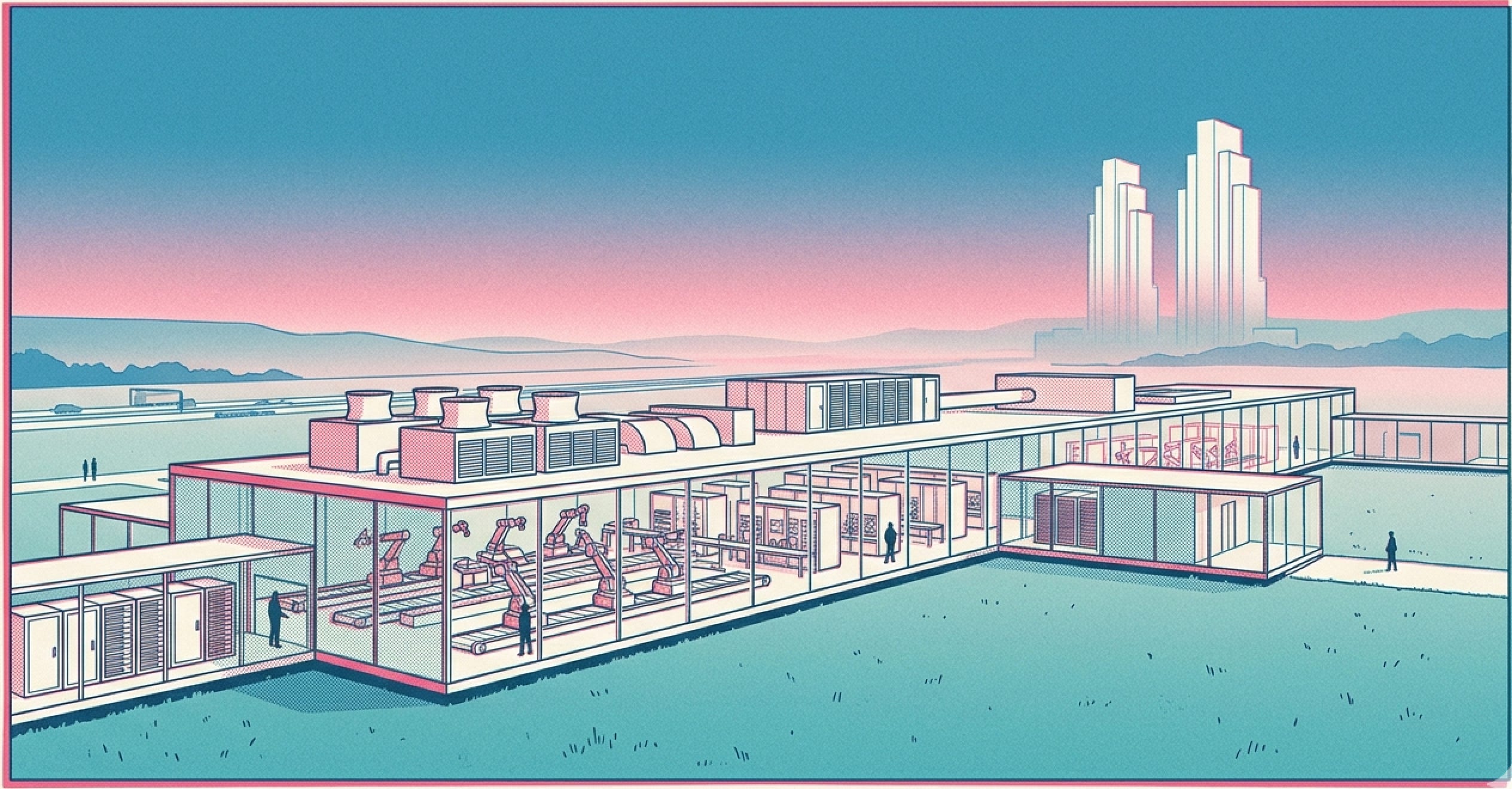
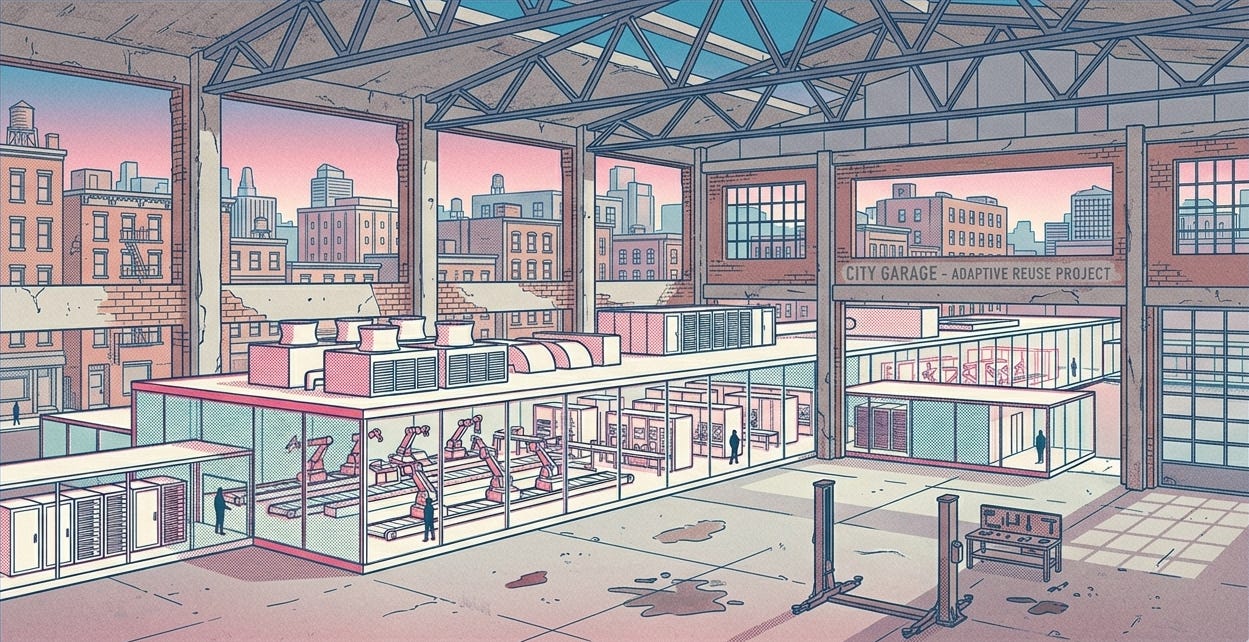
Worth paying attention to what Ginkgo Bioworks and similar closed-loop bio labs are building over on the other side of the ocean. Earlier this year Ginkgo launched its Cloud Lab — a fully autonomous lab where biological experiments run on robotic infrastructure controlled through a web browser, with AI in the design loop. That’s the shape of how the Basel scale changes next.
The signal will be a thing not built.
◆
Image credits
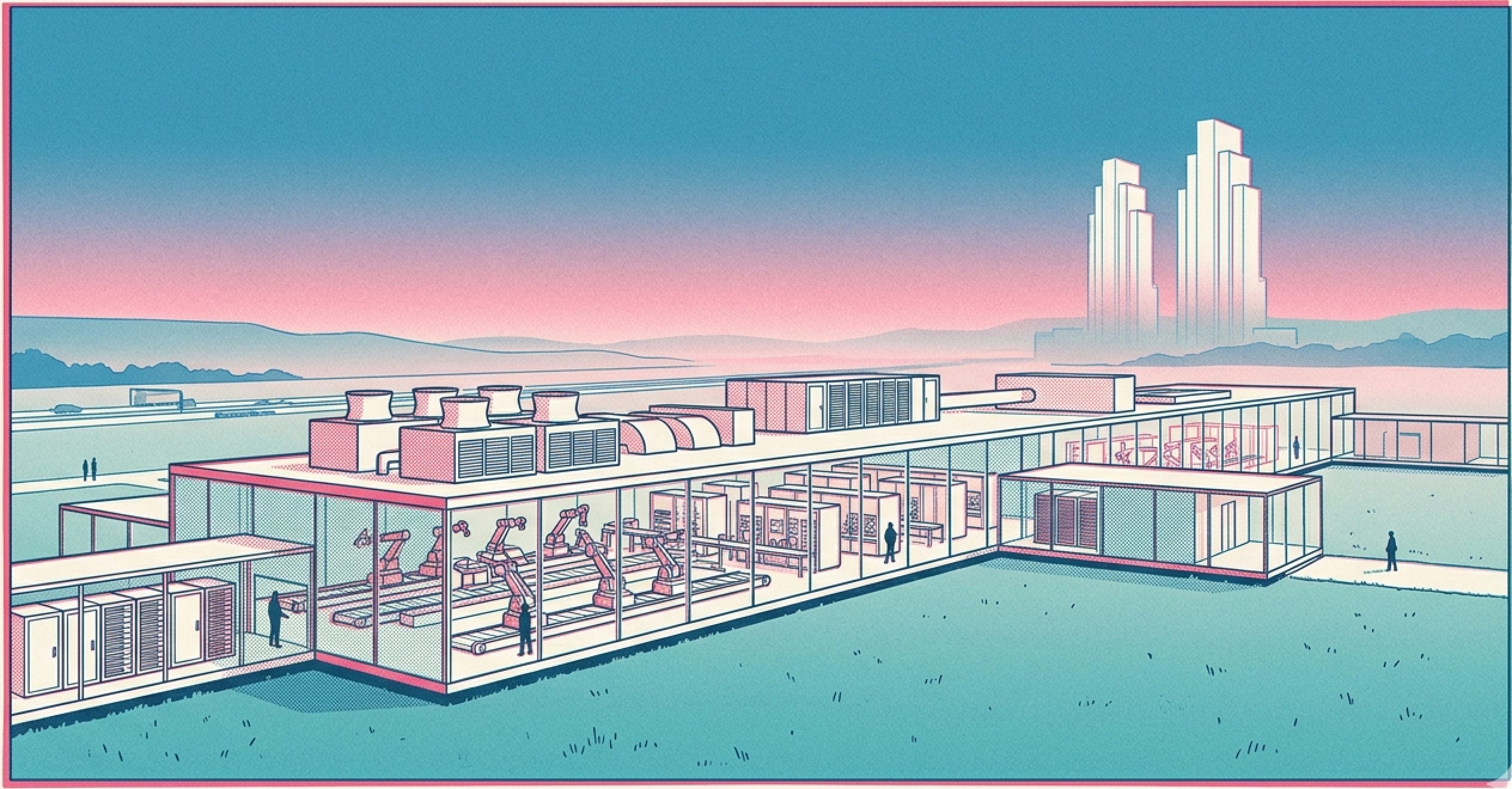
Cover and end-of-article speculative illustrations (out-of-city biolab, inner-city biolab) generated via Gemini 2.5 Flash Image from text prompts; no reference photographs.
Section 2 illustration (Hauptpost) derived from the author’s own photograph.
Section 4 illustrations are risograph-style derivatives of Wikimedia Commons photographs, released under CC BY-SA 4.0:
— Roche Bau 1 + Bau 2: photograph by Michielverbeek (Wikimedia)
— Biozentrum: photograph by Indlekoferw (Wikimedia)
— D-BSSE atrium: photograph by Alessandro Della Bella (Wikimedia)
— Novartis Pavillon: photograph by MBxd1 (Wikimedia)


All riso illustrations released under CC BY-SA 4.0.
Roche has the largest market capitalisation of any Swiss listed company; Novartis recently surpassed Nestlé to become the second. As of mid-2026, Roche’s market cap is around USD 338 billion and Novartis’s around USD 265 billion. Both companies remain among the world’s ten largest pharmaceutical firms, though now well behind Eli Lilly and Johnson & Johnson at the global top. Live figures: companiesmarketcap.com — Roche and companiesmarketcap.com — Novartis.
Roche Tower (Bau 1, 2015, 178 m; Bau 2, September 2022, 205 m — currently the tallest building in Switzerland). Wikipedia, “Roche Tower”.
Basel-Stadt resident population: ~201,000 (2024). Kanton Basel-Stadt, "Basel in figures".
Basel Area Life Sciences Supercluster reports ~33,000+ life-sciences professionals in the Basel Area; including the chemicals and biotech supply chain, pharma + life-sciences employment approaches a third of the local workforce. Basel Area Supercluster, “Workforce & Talent”.
Roche reports approximately 14,000 employees in Basel. Roche, “Science and the city: Basel”.
Schällemätteli campus development overview, including the BSS, Biozentrum, Kinderspital, and adjacent biomedicine projects. ETH Zurich, “BSS — for the biosystems of the future”.
Interesting point of view!!